This article covers three handy TIMER CIRCUITS and how to adapt
a circuit to individual requirements.
There are lots of timer circuits on the web and this is the best place to
look for a simple circuit.
However most circuits don't explain how the circuit works and
how to extend the time.
On top of this, the circuits may not exactly suit your requirements.
For instance a 555 timer circuit will consume about 10mA, just sitting and
waiting to be activated and if the circuit is operated from a battery, it
will need recharging.
Other circuits don't operate from a push button and or a short-duration
pulse or have a fixed time, even though the activating switch is kept
pressed.
That's why most timer circuits are just demonstration-circuits and don't
have a practical application.
In this article we present 3 practical timer circuits and assistance on how
to adapt a circuit to make it practical.
The first circuit is called
KEYHOLE LIGHT.
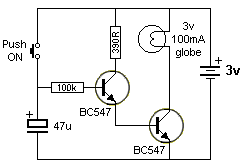
The two transistors are connected to form a single transistor with very
high gain. This is called a "super Transistor" or Darlington Transistor and
a very small current entering the base of the first transistor will allow a
large current o flow through the collector-emitter leads of the second
transistor.
There is also another way to look at how the circuit works.
The first transistor is actually an emitter-follower and as you raise the
base, the emitter rises too. The transistor is just like a fork-lift truck.
As you raise the lever with a small amount of force, the truck raises the
platform with a large amount of strength.
That's what happens here. The push switch charges the 47u and when the
switch is released, the 47u becomes a miniature 3v power supply. About 15uA
enters the base of the first transistor via the 100k and the transistor
rises until the emitter is 0.7v above the 0v rail. This makes the base 1.4v
above the 0v rail.
The transistor amplifies the 15uA about 200 times and allows 3mA to flow
into the base of the second transistor. This transistor amplifies the 3mA
about 30 times to allow about 100mA to flow through the globe.
The energy in the 47u gradually flows through the 100k and the voltage
across the 47u gradually drops. When it falls below 1.4v, the two transistor
start to turn off and the globe dims. The globe eventually goes
out and the two transistors gradually turn off. Eventually the circuit turns
off completely and consumes NO CURRENT.
The circuit can be fitted near your door and when the button is pressed, the
globe stays illuminated for about 15 seconds. The globe can be replaced with
a LED and 220R resistor. If you use a white LED, you will need to increase
the supply to 4.5v.
555 TIME-DELAY
The second circuit uses a 555 but the advantage is the consumption is zero
when not activated.
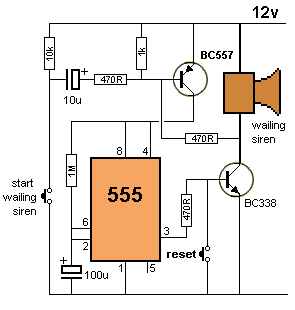
You cannot turn-off a 555. In other words, when a 555 is waiting to be
activated, it is consuming about 10mA. This is very wasteful with a battery
operated circuit and that's why we have added a transistor to connect the
555 to the power when the circuit is activated.
The uncharged 10u pulls the base of the BC557 towards the 0v rail and this
turns ON the transistor. This action connects the 555 to the power rail and
since the 100u is uncharged, the output of the 555 goes HIGH to turn on the
BC338 transistor. The collector of the BC338 is pulled towards the 0v rail
and 470R connected to the collector takes over from the switch to keep the
BC557 transistor ON.
At the same time the wailing siren is activated.
The 100u timing electrolytic is gradually charged via the 1M and when it
reaches 2/3 rail voltage, pin 6 sees a HIGH and pin 3 goes LOW to switch OFF
the BC547 buffer transistor.
This switches OFF the BC557 and the circuit shuts down.
This means the circuit is activated every time the supply is connected and
if you don’t want the siren to sound, press the RESET switch.
A 555 circuit is limited to about 10 minutes with a 470u and 2M2 resistor as
the timing components. If you want a longer time-delay, you will need to use
a chip that increases the time by using a set of flip flops. These are
building blocks that count the number of times a timing circuit charges and
discharges. Each flip flop produces an output that is effectively twice as
long as the timing circuit and if you join a number of flip flops, the end
result will be a a very long HIGH and a very long LOW.
That's what's inside the CD 4060 IC.
CD 4060 TIMER
The circuit we have presented produces a wailing sound for more than 5
minutes and the time can be extended by selecting one of the outputs as
shown on the circuit.
Normally you just need the chip and a few surrounding components, but to
reduce the quiescent current (sitting around current) to zero, you need the
two transistors and associated components.
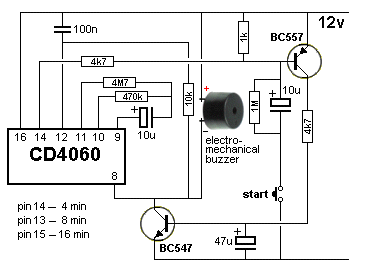
Extra parts are needed because the switch is AC coupled so the circuit will
time-out, even if the switch is kept pressed. The 100n and 10k resets the
chip to create accurate timing.
ooo00000oooo
7-8-2013
|