Welcome to
TALKING ELECTRONICS Interactive
These "Discussion"
pages let you know how we have structured
this site,
as well as provide answers to the numerous emails we get each day.
The site not a collection of "odd projects" and "ideas" that lead no-where.
It has been developed from resources that have been built-up over a
period of 20 years by a teacher of electronics, Colin Mitchell, who has
had his own electronics design-and-service business and employed staff
to manufacture all types of electronic products.
During this time Colin has written 25 electronics books containing
projects for the hobbyist and articles to help you understand the
"jargon" of electronics.
This site contains many of these projects as well as a number of new
designs. They all "dove-tail" into each other to build a library that will help you enormously when creating your own projects.
All you have to do is work your way through the
pages and "electronics will come alive."
If you have ever wanted to pursue a career in electronics, now is the
time. The projects start at the beginning with simple designs and take you
through to microcontroller applications.
Electronics is one of the most enjoyable fields you can experience and can offer a
life-long career.
Colin Mitchell has never "gone to work" in his life. "Work" has always been an
interest, a challenge and an enjoyment.
By taking up electronics, your life can be filled with an interesting
career that makes it a pleasure to be involved in.
The range of areas is enormous, from low-voltage,
consumer, industrial, servicing, design, analogue,
digital or programming, to name a few.
No matter what your areas-of-interest, electronics can find an
application.
Our website offers the first "stepping-stone." It gives you the "feel"
of electronics and lets you know how it works.
All you have to do is put a project together and feel the sense of
achievement.
If you like handling small components and soldering, you have found your
niche.
If you can "see" how a simple circuit works, you are well on
your way to understanding the things we will be presenting.
How much do you know about electronics?
Click Here for a 50 question test.
SITE STRUCTURE
Before we talk about
specific sections of the site, the first thing you should learn is
the "Art of Soldering."
We have
articles and "do-nothing" projects that
teach the art of soldering, as well as surface-mount projects and
kits
to help you solder these tiny components.
This is the way electronics is going. Surface-mount assembly is faster,
cheaper and smaller than conventional through-hole design and eventually
conventional components will dry-up from the market.
Until that time comes, we can take advantage of both types of components
and enter the wonderful world of electronics.
The first skill you will need to master is soldering.
All POPTRONICS Interactive kits are supplied with fine solder and
this is one of the most important items to improve your soldering
skills. Fine solder improves your workmanship 100%. It does this by
allowing you to feed a smaller amount of solder onto your iron and
creates a much smaller connection.
And here's a point no-one has ever mentioned before: If you add solder
to a connection while the board is almost upright, the amount of solder
remaining on the connection will be less than if the board is placed
flat on the work-bench. This is one way to create very small
connections.
The other essential item is a soldering station. It doesn't have to be a
station, but the soldering iron must be temperature-controlled and you
must have a holder for the iron. It's absolutely disastrous to have a
soldering iron floating about on the work-bench.
It really boils down to a soldering station as they are low-cost and
fully adjustable. A
suitable one is
available
HERE.
You will also need some fine
solder.
SOLDERING TEMPERATURE
Once you have a soldering iron, you will want to know how to select the
correct temperature.
It's simple:
Turn the temperature down so that the solder just melts when it touches
the tip of the iron. This is loosely called the "melting-point."
This is not hot enough. The temperature must be increased for two
reasons.
When it is increased, the flux melts faster and the joint is cleaned
more-thoroughly and the time to make the connection is REDUCED.
This is another point that has never been mentioned before. It's
actually quicker to solder at a higher temperature, and the parts stay
COOLER! That's why you need a temperature-controlled iron. You must be
able to adjust the temperature of the tip fairly precisely so the
temperature can be correctly-set to achieve quick soldering.
If your iron has a digital readout, a temperature of 325°C is suitable
for delicate work as soldering can be performed very quickly and the
components don't have time to heat up.
Each connection should be soldered as fast as possible. It should be complete
within one second. If you push each component against the PC board with
your fingers, you should not get "burnt fingers." This is the
simplest and easy way to make sure the components are not getting
damaged.
Many components can withstand high temperatures for a few seconds
but some are easily damaged. LEDs can lose their brightness, transistors
can lose their gain, electret microphones will become "noisy,"
and air trimmers will melt at the slightest increase
in temperature.
By holding a component, you are adding a heat-sink and reducing the
temperature rise.
CONSTRUCTION
Now we come to the construction-side of things.
There are two areas.
You can start with simple projects or look at our Test Equipment
section.
All our projects are built on fibreglass boards with an overlay
(component identification) and solder mask. This means
only the solder lands are visible and this prevents solder spreading to
adjacent lands. The lands are also pre-tinned to help with a quick
connection.
However it is absolutely impossible to make a quick solder-joint without
the assistance of flux.
The flux cleans the lead and the land to create a shiny connection. It
also helps to make the final connection very small in size.
If the iron is a little hotter than you think it should be (as we
suggest), the connection is also kept very small. By tilting the board
as mentioned above, the connections are also kept to a minimum.
When you are fitting the components, add only one or two at a time and snip the leads after soldering.
Never snip the leads before soldering as you may snip them too short and
they won't get connected.
Don't bend a lead more than 45° as this makes it difficult to snip. It
also make the component difficult to remove, if it needs to be replaced.
This is just the start to learning how to solder.
All you have to do is develop your skills by putting a project together.
Once you are confident you can put a project together without "lifting
the lands" or damaging a component, you will want to put more of
them
together. It's just a matter of starting.
Colin Mitchell,
Editor
TALKING ELECTRONICS Interactive
One of the most important topics on
everyone's lips is the environment and the use and wastage of ENERGY.
I
consider it is one of the most important topics of today. The cost of
energy is the controlling factor for almost everything we do. At the
moment it is in the hands of big monopolies and they are making enormous
profits from everything they provide.
Don't forget, profits come after all the exploratory expenses and
running costs.
Energy costs are spiralling and if you want to start to analyse
inflation, this is where to begin.
There is absolutely no justification for oil rising from $22.00 per
barrel to more than $125.00
Fortunately, during the recession it has dropped to about $60.00 per
barrel and is currently $80. This shows the enormous greed of the speculators, who
artificially raised the price and kept it high.
Possibly the most important aspect of the world's sustainability is the use
of its natural resources and the re-cycling and disposal of waste
products.
This is a very involved discussion and I only want to cover a very small
part of it, we shall call:
THE COST OF
ENERGY
There has been a lot of discussion about the cost of "conventional" energy,
the cost of alternate energy and the cost of "free energy."
First of all, nothing is FREE!
I am still waiting to see the car that runs on water.
The presenter of a seminar said a "water car" was sitting outside a
lecture theatre
and 5 of his friends went outside and looked under the bonnet.
I asked: "Did you take a photo?
"No."
Did you get the licence-plate?"
"No."
"Did you ask the driver to come to our meeting?"
No."
Water technology is still a SCAM, just like the Roswell invasion by
extra-terrestrials.
Don't believe anything until you see it.
And then you can still be tricked.
Take the example of the con merchant who fooled investors with "TV down
the telephone-line" SCAM. (This has recently been exposed).
He had a camera in one room, connected to a box and phone line.
In the other room he had the phone line connected to a box and TV set.
Sure enough, the signal was coming through and the picture was perfect.
So the investors bought into the SCAM.
Later it was found a very fine fibre-optic cable was added to the
mains cable of the camera and TV.
The signal never passed down the phone line!
The scam was so simple, but no-one picked it up.
My friend lost $50,000!!!
So, you can forget about anything that looks "too good to be true" -
things like FREE ENERGY don't exist.
But alternate energy does.
Before you rush into "saving the world," consider the cost to the
environment, of producing items needed to
produce alternate energy. This can sometimes outweigh the cost of simply
burning coal, oil or liquefied gas.
In this article we will look at the the real cost of producing
all types of energy and leave it to you to "consider the costs."
Everything we do will be referenced to a known consumption - a 1kW
radiator bar. We all know how effective a single bar radiator is.
It will heat a "standard room" (3m x 3m or 10ft
x 10ft) with 8ft ceiling (2400mm) and when it gets to 22°C,
it will stabilize at this temperature, if the outside temp is about 15°C.
This means the heat-loss equals heat-input and at 22°C,
the heat losses of the room are a constant 1,000 watts.
Furthermore will say it takes 1kW to produce 1HP of work from an
electric
motor as the efficiency is about 80% for small motors. For larger
motors the conversion factor is 746 watts equals 1 HP.
But here's a staggering comparison. A single person uses about 1kW of
electricity on average per hour (24kWhr per day) for lighting, heating
(via a radiator) and refrigerator. Cooking and hot water is via gas.
A car, on the other hand, uses about 87kWhr for a 100km trip. That is
about 40HP delivered to the wheels and 50kW dissipated in heat. This is
for a car that uses 10 litres of petrol per 100km. This is equal
to wasting 50 radiator-bars of heat to travel 100kM.
Can you imagine the heat released by 50 radiator bars!
Now you realise what is contributing to the heating of the planet (I am
not saying this is causing any problems) - just the comparison of our
energy usage.
Now we will cover the cost of "conventional energy" - ELECTRICITY and
GAS, as supplied to a standard house in Victoria, Australia in 2011.
These figures do not include "Service charges" etc.
| ELECTRICITY |
17c per kWHr |
| GAS |
5.1c per kWHr |
| BBQ GAS |
20c per kWHr |
In other words, a single radiator
bar using electricity will cost 17c per hour or 5.1c if it is powered by
gas. Bottled gas, called BBQ gas, is the most expensive, as it has a
"filling cost."
Electricity is 100% efficient. There are no flue-gasses or
losses.
Gas is 75% efficient as about 25% of the energy goes up the flue as
"gasses of combustion" when used in central heating.
Gas is quite often used for "burners" in "cook-tops" as it is
"instant-heat" and can provide more energy than electricity.
An electric element is limited to 2400 watts whereas a small gas burner
is 1.1kW, medium is 1.8kW and large is 3.1kW. A Wok burner is 4.2kW.
Clearly, this amount of output cannot be provided by an electrical supply.
You quite often see the output of a gas heater as BTU per hour
Our hot water service is 42,000 BTU/Hr (this is called an input-value)
Our central heating is 120,000 BTU/Hr (input)
| 42,000 BTU/Hr |
=12,300 watts |
75% efficient |
=9,200 watts |
| 120,000 BTU/Hr |
=35 kW |
75% efficient |
=26kW |
THE SHOWER
A 42,000 BTU/hr hot water heater
will produce 120 litres of hot water in one hour (this is allowing for
75% efficiency and water raised from 15°C
to 80°C.
We have not taken losses from the tank into account due to poor thermal
insulation).
Instant hot water heaters are slightly more efficient (stated as 95%),
but the largest unit has an input of 152MJ/Hr (42kW) (142,800 BTU/Hr)
and this can produce only 24 litres per minute with a temperature rise
of 25°C.
Incoming water is generally approx 12°C,
so the output is really only 18 litres/min as the water from the head of
the shower has to emerge at 44°C
for a shower at 42°C.
The water looses 2°C
in falling. This hot water unit is suitable for a 12 litre per
minute shower, but hopefully no-one else in the house will turn on a tap
when someone is showering!
The actual cost of taking a shower is quite expensive.
The shower-head used by the author is 5cm diameter and has medium-sized
holes. The rate of flow was measured at 7 litres per minute at a
temperature of 43°C.
If the inlet water is 20°C,
the temperature-rise is 23°C.
Since 1kWhr = 860,000caloires and 1 calorie is the heat required to
raise 1gm of water
1°C,
we can work out the heat required and the cost.
The cost of heating this water per minute using electricity is 7,000 x
23 = 161,000cal
For 1 hr = 9,660,000 = 11.2kW
Cost per minute = 3.2cents
The cost for gas is 2.5cents per MJ (with all service charges included)
1MJ = 240,000 cal
Gas usage per minute = 0.67MJ = 1.6cents per minute. Gas
heaters are only 75% efficient and the cost of keeping the water hot,
adds another 30%, making the total about 2.7 cents per minute.
Summary:
| 42,000 BTU/Hr |
=12,300 watts |
75% efficient |
=9,200 watts |
| 120,000 BTU/Hr |
=35 kW |
75% efficient |
=26kW |
152MJ/Hr
142,800 BTU/Hr |
=42kW |
75% efficient |
=31kW |
1kW will produce
0.57litres of water (raised 25°C) per minute
1kW will produce 34litres of water (raised 25°C) per hour
(17cents) |
| A shower delivering 7 litres/min
(a very gentle flow) requires 12kW |
| A shower delivering 7 litres/min
costs 3.2cents/min |
| Hot water has the stored energy
of approx 1kw-hr per 1,000 litres per degree C |
GAS HOT-WATER
STORAGE
Many houses have a
mains-pressure gas or electric hot water storage unit. They are better
than instant water-heaters as the temperature of the water is more
reliable. The temperature of instant heaters seem to fluctuate according
to the pressure of the mains, especially if someone else in the family
turns on a tap.
We will deal with only a mains pressure GAS HOT WATER storage
unit with a capacity of 135litres. This is one of the smallest units on
the market and the tests were taken over a 14 day period of time
to make them reliable.
Gas heaters are only 76% efficient when heating the water, 24% of the
heat is wasted as flue heat. This figure has been taken from Vulcan
specifications: Input 35MJ/hr Output 7.3kW.
But there is another inefficiency to take into consideration. To keep
135litres hot, takes 3.35kWhr each day. This is almost another 25% of
the heat required to maintain temperature.
This means the overall efficiency of a gas hot-water heater is about
50%.
No-one has ever taken the trouble to work out the efficiency of this
type of heater and a larger storage unit would be slightly more
efficient. But the inefficiencies are considerable when you
consider 100,000's of heaters are used in each country.
CENTRAL HEATING
If a 120,000 BTU/hr central heating unit has 7 outlets, each outlet will
deliver 3.7kW
Again, this is clearly more than any electrical outlet can supply.
That's why we use gas.
VEHICLE
CONSUMPTION
Cars are another factor in using fuel inefficiently. A standard petrol
car uses about 30% of the energy of the fuel to move the car. The
remaining 70% is lost in noise and heat.
An average car uses 10 litres of fuel to travel 100km. The energy from a
litre of fuel is about 45MJ/kg but a car can only produce about
17.6MJ/kg of work.
If a car travels at 100km/hr, it consumes 10 litres or 8kg of fuel.
This 8 x 17.6 = 141MJ
3.6MJ = 1kW
So the car is delivering 39kW
39kW = 52HP
On a cost-basis, the 39kW has cost the motorist $12.00 or 30cents per
kWHr @ cost of petrol = $1.20 per litre.
On a distance-basis, the cost to the motorist is 12c per km.
The actual cost of fuel (petrol) is 12c per kWHr - meaning the amount of
heat that can be obtained by burning the fuel in a 100% efficient
reaction.
The cost of LPG (Liquefied Petroleum Gas) is about 7c per kWHr. -
meaning the amount of heat that can be obtained by burning the fuel in a
100% efficient reaction.
| Petrol |
45MJ/kg |
32MJ/litre |
Burn 50 litres (in 1hr) =
450kWhr |
| LPG |
45MJ/kg |
25MJ/litre |
Burn 50 litres (in 1hr) =
350kWhr |
LPG has 80% the calorific value
of petrol on a VOLUME BASIS and this is how we buy each of the fuels. In
other words, if 10 litres of petrol moves a car 100km, 10 litres of LPG
will move the car 80km.
LPG in Australia currently costs 50% of unleaded petrol and since it has
only 80% of the calorific value, this equates to 60% the
cost of unleaded petrol on a mile-for-mile basis.
ELECTRIC CARS
We hear so much about cars of the future being electric.
Let's analyse this logically.
To charge an electric car from a normal power point is going to take
many hours.
A 240v normal power output will allow 10amps to flow without overheating
the wiring.
This is 2400 watts or 3.2HP
If you charge an electric car for 8 hours and the car travels 300km at
60km/hr, the average power delivered by it will be 8 x 3.2 / 5 =
5.12HP
The model T Ford had an output of 10 brake horsepower and this was
considered sufficient for the first 10 million cars.
However an electric car will need to have two 5HP motors to be equal to
the Model T Ford but these are much
more "effective" than a petrol motor of the same rating.
An electric motor will provide much more acceleration and provide much
more performance than a petrol motor.
If the car is driven very carefully and the requirement is not more than
the equivalent of 5HP, it will get a range of 300km.
The stored energy will need to be 8 x 2400 = 19,200 watt-hrs.
The 12v battery in a normal small car is about 50 amp-hrs or 600watt-hrs and a 12v
battery in a large car is about 90-100amp-hrs or 1,200watt-hrs. This means you would need
20 x 12v large batteries to power the electric car we are discussing.
Car batteries produce about 100watt-hrs per kilogram. This means
we need 19,200/100 = 192kgm of battery.
The cost of charging an electric car with a range of 300km, compared
with a 5HP petrol car:
| Electricity |
8 x
2400 watts |
15c/kw-hr |
$2.80 for 300km = 95c for 100km |
| Pertol |
50HP car costs $12.00
for 100km |
Petrol $1.20/litre |
A 5HP car would cost about 1.20
for 100kms |
Thus you can see a petrol
car of the same horsepower rating would cost about the same to run.
But the petrol car would need only 20km of fuel, as opposed to
192kgm for batteries and the petrol car can be refueled instantly at any
petrol station.
In an electric car you are carrying around the dead-weight of at least 2
passengers in the form of a battery.
5 - 10HP will propel you along a flat road at 80km/hr with 1 passenger
(and 192kgm of batteries) but will slow you to less than 50km/hr on a
hill. Don't forget, the weight of your electric car will be more than a model T-Ford.
ENERGY
CONSUMPTION
The only way to work out the overall cost of energy in a household is to
work out the ENERGY CONSUMPTION per day.
We will take the example of a single person. For two people, add 20% and
about 10% for each additional person.
There are 5 energy requirements: Heating, lighting, hot water, cooking
and appliances.
We have already mentioned the cost of heating is 1kW for an "standard
room." If the room is heated from 5pm to 11pm, the consumption will be
6kWHr.
We will allow a total of 1kWHr for lighting per day.
A 10 minute shower using 11 litres per minute will use 110 litres of
water. 50% of this will be hot water, requiring an input of 4.5kWHr.
Cooking will require 1kWHr
Fridge, washing machine, kettle, micro-wave oven will consume another
2kWHr per day.
A TV adds another 2kWHr.
The total minimum is: 15.5kWHr per day.
This is an average of 620 watts continuous but the demand comes in
bursts and this could be as high as 5kW for a short period of time -
such as a kettle and tumble-dryer at the same time.
That's why a household needs three different forms of "renewable
energy" - if you are deciding on renewable energy.
Here are 5 different "low-cost" energy solutions:
1. Wind generator
2. Water turbine,
3. Solar heat box or solar heat-wall,
4. Solar pipes on the roof to heat water,
5. Solar cells,
6. Wood fire
7. Bio gas.
The biggest problem with all forms of energy generation, is storing or
producing the energy when required.
The problem is to store it during the day and use it at night, or to store it
from one week to the next or from one season to the next.
If we could store the solar energy that reaches our roof, we would all
be millionaires. A typical roof on an 18 square house absorbs over
450kWHr of heat on one sunny day! 18 squares is equal to more than 180m2
of roof, but we will use 90 m2
(90 m2 x 5 hours x 1kw/m2 = 450kWHr)
If this could be converted by a heat-pump to high temperature energy and
stored in a water-tank or heat-bricks, we would never need to buy energy
again. A simple steam turbine could be used to generate electricity and
we would be self-sufficient for ever.
But this is sadly not possible for everyone. That's why the energy utilities are
using us as "piggy banks."
Electricity is supplied to Alcoa (an aluminium manufacturing company) for 3.5c per kWHr and Liquefied Natural
Gas is supplied to China for 5c per litre.
Our costs are 17c and about 75c.
This brings up two points. If we paid less for electricity and gas,
would we use more? If we paid less for energy, would be invest in
"alternative sources?"
Don't get hooked on the carbon dioxide debate. Carbon dioxide comprises
only about 0.03% to 0.06% of the content of air and it has only risen 0.001% in the
past 100 years.
It is a contributing factor to global warming but when you realise the
amount of heat delivered to the earth from the sun, the effect of
bush-fires and things like steel production, the contributing factor of
households is miniscule. Look at the wasted street lighting and office
lighting at night-time.
Freeways could have the lighting triggered by vehicle movement so that
whole highways of lighting could be turned off when no traffic movement
is detected.
Australia is one of the largest polluters of the planet. Maybe not
directly, but by mining hundreds of millions of tones of coal and iron
ore, the end result is millions of tones of carbon dioxide released to
the atmosphere ever year. (330 million tons - coal 320
million tons - iron ore).
It does not matter if the carbon-dioxide is released in China or
Australia, the end result is world-wide pollution. Each kg of coal
produces nearly 3kg of carbon dioxide.
Australia produces 1,000 million tons of carbon-diode per year due to
the burning of its mined coal.
A blogger has come up with a
very similar comparison on energy:
https://greennav.wordpress.com/2008/03/03/how-much-energy-in%e2%80%a6-cars/#comment-8791How much energy in… Cars
kWhs are the most common unit
electricity is measure in. For me the easiest way to think
about it is to think about light bulbs. If you had ten 100W
bulbs, and you left them on for 1 hour, they would have
consumed 1000Wh (Watt-hours), or 1kWh (kilo meaning
thousand). An old one bar heater is usually a 1kW heater,
meaning if it was on for one hour, that would be 1kWh.
Finally if you left one 100W bulb on for 10 hours, you would
consume 1kWh.
Joules is just another unit that energy
is measure in. 1 kWh = 3600kJ (kilo-Joule)
So here is a small table:
|
|
|
kWh |
|
1kWh |
Electricity |
1 |
|
1m3 |
Gas |
11 |
|
1 litre |
Petrol |
9.7 |
|
1 litre |
Diesel |
10.7 |
|
1 litre |
Biodiesel |
9.9 |
|
1 litre |
Kerosene |
10.5 |
|
1 kg |
Coal |
6.64 |
So, to take that in Car mode. A petrol
car that gets 35 miles/gallon would equate to about 0.8
kWh/mile, or 1.29kWh/km.
So driving your car for 1 km, and
leaving 21 X 60Watt bulbs lighting for one hour… is about
the same.
Or look another way… to drive 1 km
takes about 36 seconds. In lighting terms that is equivalent
to 2150 X 60watt bulbs… Yes.. your car is equivalent to
2150 light bulbs. Far more if we were to consider the
energy efficient type of bulbs!
You can actually do much better than 100% with electricity.
It’s counter-intuitive I know but a dual-cycle
air-conditioner gets more like 350% efficiency (and even more
for ground-sourced versions).
i.e. you “burn” 1 kWh of electricity and get 3.5 kWh of heat
into your house.
It’s called the “coefficient of performance” … and it’s not
anything to do with free-energy… essentially it works because
the refrigeration cycle makes the refrigerant extremely cold
(say something like -70 degrees). Then, when you put it outside
it can gather a huge amount of energy from the relatively hot
outdoor air. The air might only be 5 degrees, but that makes it
75 degrees hotter than your refrigerant. There is a lot of
energy transfer with such a big temperature difference.
You then get to put this energy into the house as heat.
|
SOLAR
ELECTRICITY
Let's look at one of the
worlds biggest frauds.
It's SOLAR ELECTRICITY.
To be more specific it's electricity generated via solar panels.
If we take the cost of producing a solar panel and compare it against
the electricity generated, we find an amazing disparity.
Even though the cost of producing electricity via coal has a side-issue
of carbon-dioxide production, the increase of carbon dioxide in
the atmosphere over the past 100 years has been less than 0.001%.
Coal has a heat value of 30,000 BTU per kg (13,000 to 33,000 BTU/kg)
Burning 1kg of coal per hour will produce about 9kWhr (at 100%
efficiency). Coal fired electricity generating plants are about
25%efficienct, so that 2kWhrs of electricity is produced from each kg of
coal.
This means the return is about 7 cents, as electricity is sold by the
generating plants for 3.5c per "unit" and bought for 45cents to 60 cents by the
consumer (via the Australian Solar Electricity Scheme).
The Australian government is offering $8,000 plus $1450 = $9,450 for a
1kW solar system in the form of 6 x 175watt solar panels attached to the
roof.
This system will produce a maximum of 5kWhrs per day over a period of a
year for areas such as Victoria.
The second part of this rort (fraud) is the condition that an
electricity provider will buy back electricity at the rate of 45-60
cents per kW-hr, even though they are providing electricity at the rate
of 16 cents per "unit."
This is one of the "gimmicks" provided by the government to encourage
householders to "do their bit for the ecology."
When you work out the energy required to manufacture the solar panels,
the wiring and the cost of the inverter, you will never recoup the damage to the
environment. The poisons produced by the etching and cleaning of the
silicon wafers far exceeds any savings in carbon-dioxide.
None-the-less, 100,000 Australians have signed up for the scheme and put
the government in the position of having to halt it as it overflowed by
more than 700 million dollars in a single year.
If you work out the effectiveness of the scheme, it has cost 700,000,000
dollars to produce 100,000 x 5 x 365 x 25 years = 15 cents per kW-hr
over the lifetime of the project.
Compare this with electricity production at 3.5 cents and selling for
16cents.
The government could build a generating plant for $700 million and sell
the electricity it generates. Obviously a $700 million plant would
produce more than the 500Megawatt-hrs produced by the solar panels per
day. The solar panels are actually outputting at a constant rate equal
to a 20MW generator (5/24hours).
Solar production is one of the most inefficient (and costly) methods of
production.
Although hydro involves a massive infrastructure and damage to the
environment, it offers a dual return in providing water throughout the
year and electricity generation.
But there are other alternatives that produce enormous amount of
electricity.
1. Geothermal energy.
2. Tapping the heat generated at varying depths from a body of salt
water.
3. Tidal energy.
4. The amount of energy generated from water flowing into and out of a
bay each day is phenomenal.
5. Wind energy.
Almost every country has one or more of these energy sources available
for exploitation and it is time for governments to consider tapping
these reserves and delivering at a rate not exceeding 5c per unit.
If the Australian government has a little intelligence, it would have
put its $700 million to better effect by exploring water, wave, wind or
tidal energy.
A wind turbine costs approx $1.5 million per megawatt. You do the sums
and see how inept the government is.
MORE IDEAS
Now we come to the point of being
able to produce energy at a lower cost.
Unless you have a thermal geyser under your property, the only three
inputs you have available are: wind, sun and water.
One of the most popular methods of generating electricity is wind.
It has been proven that a large wind turbine can produce about one
megawatt of electricity on a fairly constant basis when the turbine is
placed in a windy location. The recent debate of their ugliness
has been overturned and the disgusting fraud perpetrated on the industry
by nature conservationalists has been exposed. They predicted birds
would be killed when they flew into the blades (turning at 20rpm!) and
sure enough, dead birds were found on the ground soon after the turbines
were installed. So the authorities installed cameras and found the
conservationalists were dumping dead birds during the night!
When you get up close to a 30 metre tower and see the revolving blades,
it is certainly a sight to inspire. The turbines are only a few hundred
metres apart and a few acres of land can generates 15 megawatt.
The only deterrent is the cost of installation and this will come down
when they are mass produced.
For the individual householder, a small generator may be the answer. But
when you find out the maximum blade diameter allowed is 1.2m you will
quickly realise the maximum generating power is 1kW. The law will have
to change

The cheapest type of generator is water. For any type of water turbine,
it will operate 24 hours a day.
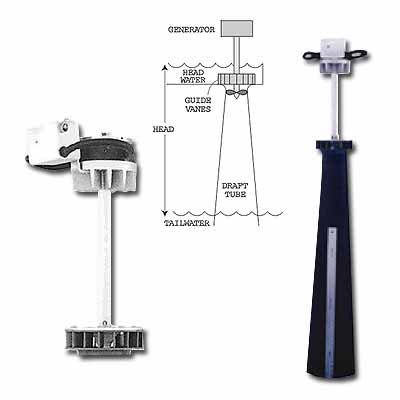
The diagram below shows a water turbine that produces 200watts of power with only two feet of head
and a Kilowatt of power -- enough to completely power an average
household -- with only 10 feet of head. The design uses a very clever
"draft tube" to take advantage of the falling water and thus draws the
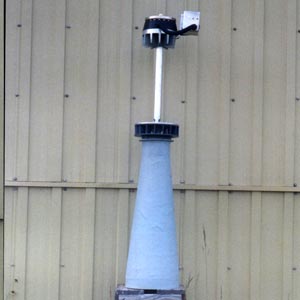
water through the blades of the turbine. The second photo shows the unit
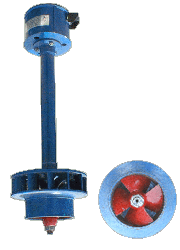
on a wooden seat. The "draft tube" is clearly seen. The third photo comes from a company based in
Jakarta, Indonesia. They represent manufacturers from Europe, US
and other Asian countries. The two generators look very similar.
The US company sells the generator for US$2,200.
Suppose it lasts for 8
years and produces 24kWHr of electricity per day.
The cost per kWHr will be 3.1 cents.
Another type of water turbine is shown in this
movie (1MB). The
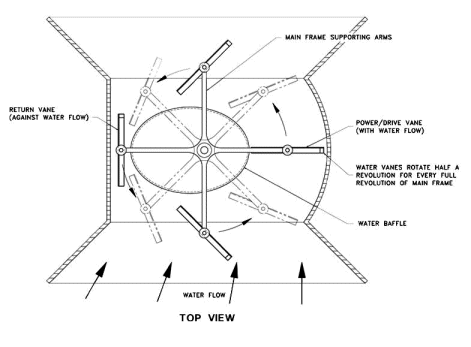
diagram below shows how the blades are turned so they do not present
themselves fully to the oncoming water. This provides a much-greater
area to the flow of water in the forward direction but introduces a number of joints
at the top and bottom of each blade, that need to
be protected from wear. A much simpler and more efficient solution is to
mount the turbine transverse on a barge so that only the
lower half of the drum presents itself into the water. In this way
the returning blades would not be forced against the flow of
water. The shaft could also be taken to an in-line gearbox to
increase the rpm about 7 times and the output from the size
presented in the 10 second movie would generate about 5kW. Installation costs would
also be reduced enormously. The diagram below shows how the vanes
turn to reduce the force against them when they are returning. A very
clever idea but quite complex.
The cost of a 1kW design is $5,000 plus $5,000 for installation. The
projected cost for the electricity produced over a 10 year period is
50c per kWHr as per the website.
This invention can be found at:
http://www.sundermann.com.au/index.html
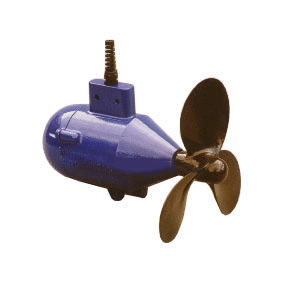
There are a number of other designs including an under-water model shown
in the photo below. It will produce 100 watts in a fast-flowing stream.
By far the best place to look for any items associated with renewable
energy is on eBay. Suppliers and manufacturers are very reluctant to
provide prices, whereas eBay gives a huge choice of items and prices.
Similarly, a search for articles on renewable energy via Google will
provide you with a huge range of options.
After searching the web for some considerable time, the following
figures were found for power generation from water and wind.
It can be clearly seen that the power available from a simple water
turbine is much greater than a wind turbine due to the density of
water.
The formula is:
Power = ½ p A V3 watts
where p the density of water, A
the area swept by the rotor blades and V the stream velocity. The marked
difference in power generated by water compared to that of wind, however,
may be seen from the table for various velocities assuming a density for
water of 1000 kg/m3 and an air density of 1.2473 kg/m3 corresponding to
air at 10 °C.
|
Velocity
m/s |
Water
kW/m2 |
Wind
kW/m2 |
| 1 |
0.5 |
|
| 2 |
4 |
|
| 3 |
14 |
0.2 |
| 10 |
5000 |
0.6 |
| 15 |
|
2.1 |
| 20 |
|
5 |
A stream of water flowing at 10 metres per second has the potential
to generate up to 5 megawatt of electricity for a simple paddle
measuring one square metre! We can only get a maximum of 60%, but even
if we could only get 1%, it would represent 50kW!
There is much more energy in a flowing stream than we have ever been
told and it will just take someone to produce a simple paddle wheel
connected to a pulley to drive an intermittent pulley that drives a
final pulley on a generator. The two stages of drive are needed to get
the rpm up to about 1000 rpm to make the generator efficient.
A single v-belt will transmit about 5-10HP so you will need a pulley at
each end of the paddle and two or four 5kW generators to get
enough for a dozen houses or so. All the merging of the output of the
generators can be done with electronics and it's just a matter of
fabricating the paddle on a barge.
This type of power generation plant will not upset the flow of any river
as no dam needs to be constructed. The barge is held to the bank with a
pole on a loop and will rise and fall with the river. The barge is also
tied in position with guy wires.
All this can be done for less than $10,000 and the electricity supplied
at about 5c per "unit."
Surplus electricity is passed to "dummy loads" consisting of heaters in
a water tank. In this way the system heats water for the household as
well as all the other requirements.
While on the topic of energy conservation, we hear a lot about "saving
the planet;" buy high-efficiency globes.
Our local council is providing a FREE change-over service. They will
change all your "inefficient incandescent globes" for Compact
Fluorescent Lights.
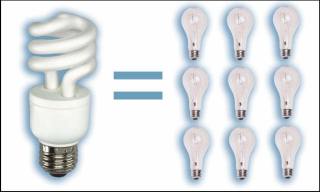
One CFL will outlive 9 ordinary
globes!!!!
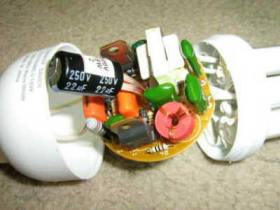
Inside a CFL
But have you considered the amount of energy required to manufacture
all the components in a CFL. The picture above shows the enormous number
of components required to produce the high strike-voltage and
current-limiting once the tube has struck.
What is going to happen to all the good globes that have been replaced!
What is going to happen to the CFL lamps when they eventually fail? What
is going to happen to the tiny amount of mercury gas if the lamps get
smashed?
Most of the CFL lamps fail prematurely due to heating and drying-out of
the electrolytic and faulty solder-joints. Most do not see the predicted
"9-lives." The reason is the lamp is mounted up-side-down from
the ceiling and the heat from the lamp rises and heats the electronics.
This was never taken into account when the lamps were "soak-tested."
What is the point in saving a few watts when Australia is supplying
China with millions of tons of coal each year? The ships are lined up at
the wharf, 24 hours a day waiting to be loaded. Each kilo of coal
produces 2kg of carbon dioxide.
What about looking at the city with the lights in every office burning
24 hours a day. What about looking at the lighting under bridges. If you
count the number of 500watt bulbs per underpass, you could supply 100
houses with electricity.
No. It's all a myth. We are not "saving the planet" and no amount of
conservation will overcome the enormous amount of degradation taking
place by the multinationals. Not that they are to blame. It is the
consumer that wants everything wrapped and presented in an attractive
way. It is the consumer that "half-uses" everything and throws the rest
away.
You only have to look at hard-rubbish collection each year. Nearly every
house has a TV, microwave oven, chair, lounge, BBQ, VCR or computer to
be picked up. And the next year the pile is even greater. Our houses are
absolutely stacked to the ceiling with devices we use as well as devices
ready for the tip.
You have to remember one thing. Every shipping-container of product that lands on
your shore will have to be dumped in a tip at some time. Our
sea-terminal gets 500,000 containers per year. Multiply this by the
number of terminals in the world.
What is changing 20 globes going to do to conservation?
Think of it in fractions of a millionth of one percent.
One interesting thing that has come from LED technology is the improved
clarity and truer colour produced by LED street-lighting. The photos
below seem to show the improved appearance from LED lights, over the
sodium lamps. I have not seen the improvement myself. The LED
lamps use approx 50% less energy. The improvement may be due to
the resolution of the camera and may not be seen by our eyes.

|