|
The MOSFET |
A MOSFET is a transistor. It
is a Metal Oxide Field Effect Transistor.
Here are the symbols for FETs and MOSFETs:
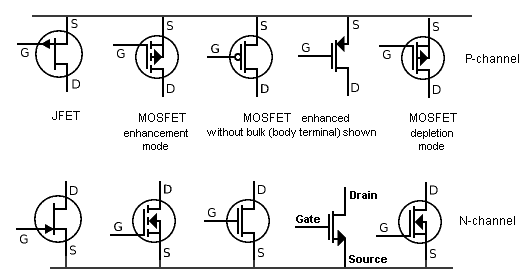
The MOSFETS have been drawn in
these positions because
that is how they will be located in a bridge arrangement
and you can see how and where the three
terminals will be.
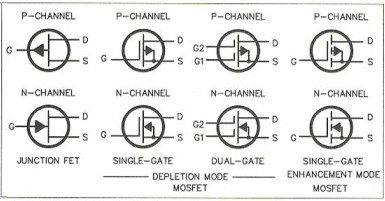
More MOSFET symbols
Here is an animation showing how to turn on an N-channel MOSFET:
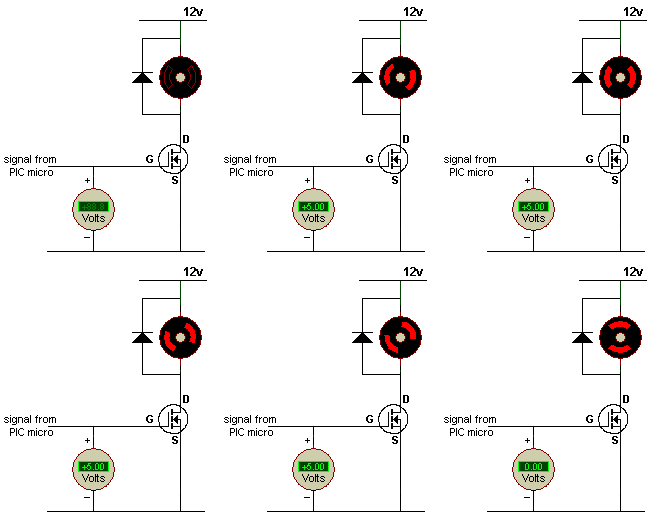
MOSFET turns ON when
gate-to-source
is more than about 2v (2v to 5v)
The easiest way to understand how MOSFETs
work is to compare them with PNP and NPN transistors and show them in
similar circuits. The advantage of a MOSFET is this: It requires
very little current (almost zero current) into the gate to turn it ON
and it can deliver 10 to 50 amps or more to a load.
THE BASE
The BASE (the input lead)
of a normal transistor is the GATE for a MOSFET.
A MOSFET can be used in place of an ordinary transistor (called a
bipolar junction transistor, or BJT) providing one slight difference is
taken into account.
An ordinary NPN transistor will turn ON when the base voltage is about
0.65v more than the emitter but a MOSFET needs the gate terminal to be
at least 2v to 5v, (depending on the type of MOSFET) above the source
voltage.
This is called the GATE VOLTAGE and the exact value is
difficulty to extract from some data sheets.
That's why you need to know the value before using a FET or
MOSFET.
Delivering a higher voltage (up to 12v) will not damage the device or
cause more gate current to flow but supplying a minimum voltage will
alter the current capability enormously. You must not use a MOSFET if
you can only just deliver the minimum gate voltage as the MOSFET will
act like a high-power resistor and get very HOT.
When a MOSFET is used in a high-current situation, it is important to
provide a fast rise-time to the gate so the FET turns on quickly and
does not heat up.
If you have a circuit with a fast rise-time voltage in the order of 2v
to 10v, a FET device is a good solution.
You can find the GATE VOLTAGE by building the circuit and testing the
MOSFET.
Connect a 100k pot to a 12v supply and take the wiper to the gate
terminal.
Gradually increase the voltage by turning the pot and measure the
voltage across the LOAD. When the voltage is equal to full rail voltage,
the FET is fully turned ON. Perform this operation as fast as you
can to prevent the FET heating up. Hold your finger on the FET and
reduce the voltage slightly until the FET starts to warm up. Measure the
voltage on the gate with a digital meter. Now increase the voltage so
the FET remains cold. Measure the voltage.
You now have the required gate voltage for the device and a minimum
voltage (the gate voltage must be above the minimum voltage).
Here is a comparison between an NPN transistor and N-channel MOSFET:

A zener must be added to the gate of a
MOSFET if the gate voltage comes from a supply that is above 20v.
A normal transistor is a current amplifying device.
For a load current of 100mA, the base current for a BC547 will need to
be about 1mA.
This means it has a current gain of about 100.
A MOSFET is a voltage controlled device and the current it will handle
depends on its physical size and the way it is constructed. You cannot
change this parameter.
For a load current up to about 35Amp, the gate current for a IRZ40 will
be less than 0.25mA. When the gate voltage is 3v to 4v higher than the
source, it turns on and the resistance between source and drain
terminals is about 0.028 ohms. It will handle up to 35 amps.
The load determines the current through the MOSFET (not the MOSFET) and
if it is less than 35 amps, a IRFZ40 is suitable for the application.
Comparison between a PNP transistor and P-channel MOSFET:
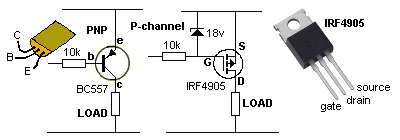
When the gate voltage is 4v LOWER than
rail voltage, the MOSFET turns ON. The 10k resistor on the base of the
transistor is needed to prevent the base current exceeding the amount of
current needed by the transistor to deliver current to the load. However
the 10k resistor on the gate of the MOSFET is not needed. Providing the
voltage (up to 18v) on the gate rises and falls quickly, the MOSFET will
not get hot. The critical period of time is the 0v to 3v section of the
waveform as this is when the MOSFET is turning on.
PUSH PULL
MOSFETs can be placed in push-pull mode,
just like PNP and NPN transistors.
They must be connected correctly to prevent damage.
In the following circuit you can see the transistors and MOSFETs have
been connected incorrectly.
For the PNP/NPN transistor circuit, as the input changes from high to low
or low to high, both transistors are turned on during the transition.
Only one transistor is turned on when the line is high and only the
other
transistor is turned on when the line is low, but during the transition,
BOTH are turned on.
The same applies with the MOSFETs. When the input is at mid-rail, a
voltage between gate and source will be produced for both MOSFETs. Since
a MOSFET can handle many amps, this will put a short-circuit across the
power rail and will cause a lot of damage.
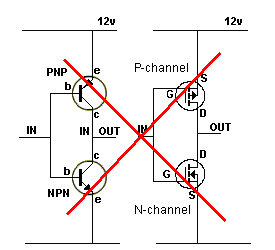
Transistors and MOSFETs
will produce short-circuit
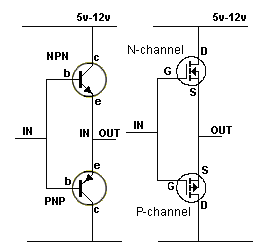
The solution is shown in the diagram below. The transistor configuration will work on ANY rail voltage but the MOSFET "totem-pole configuration" will only work up to 5v. This is due to the characteristics of a MOSFET. The MOSFETs used in this arrangement have a gate-to-source characteristic of slightly more than 3v and do not turn on when the voltage across these two terminals is 3v. This means the supply can be 6v and when the input is at mid-rail, 3v will be across each gate-to-source and neither will be turned on. That's why TTL logic is limited to 5v operation. The output will be extremely close to rail-to-rail for the MOSFET configuration.

For a supply greater than 5v, a different MOSFET configuration must be used to get full rail-to-rail output. The MOSFETs must be turned on individually.
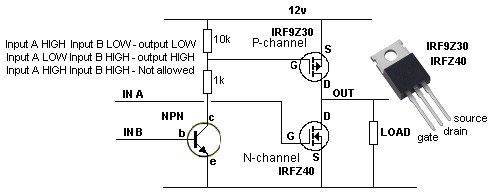
PUSH PULL USING MOSFETS
The circuit above sinks up to 35A via the N-channel MOSFET and delivers
about 18Amp via the P-channel MOSFET. Input A must rise quickly
to prevent the MOSFET heating up during the turning-on period. Input
A must rise to at least 4v to guarantee the MOSFET turns ON.
Input B must rise above 0.65v to turn the transistor ON. The
voltage on the collector of the transistor will fall and this will
provide a gate-to-source voltage for the P-channel MOSFET.
Both inputs must not be HIGH at the same time as this will turn ON both
MOSFETs and create a short-circuit on the power rail.
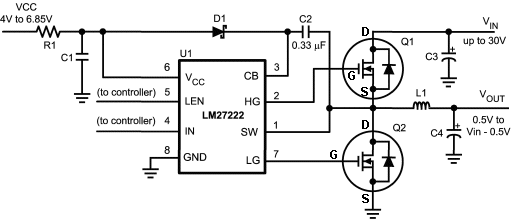
The circuit above is much more complex than
meets the eye.
To turn on the top N-channel MOSFET, the gate must be taken at least 3v
higher than the source because it is a SOURCE FOLLOWER (similar to an
EMITTER FOLLOWER). This is equal to Vin + 3v.
How does pin HG get this high voltage?
It gets it from a voltage doubling circuit made up of the 0.33u, high
speed diode D1 and an oscillator in the chip.
The circuit is a buck converter and will reduce any supply voltage to a
lower voltage with very high efficiency. It allows a small "packet of
energy" to flow to the Vout terminal via the inductor L1 and this
percentage determines the Vout voltage.
Here is an audio amplifier using PUSH PULL mode to drive a speaker:
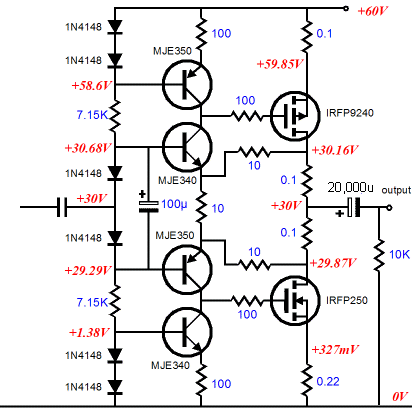
The top two transistors are in push-pull mode to turn the P-channel
MOSFET on and off very quickly. They speed up the incoming waveform and
prevent the MOSFET generating heat during the turning-on process.
The two lower transistors do the same thing.
The diodes and resistors connected to the input form a voltage-divider
to correctly bias the push-pull transistors.
H-BRIDGE
An H-Bridge can be designed using MOSFETs:

Input A HIGH, Input D HIGH - forward
rotation
Input B HIGH, Input C HIGH - reverse rotation
Input A HIGH, Input B HIGH - not allowed
Input C HIGH, Input D HIGH - not allowed
The H-Bridge can be designed with two more transistors so that only two
input lines are needed.
PWM MOTOR SPEED CONTROLLER
Here is a circuit from a 12v drill. The MOSFET will deliver up to
30Amps.
The frequency of the oscillator is in the range 550Hz to
about 6.5kHz, with an off period of about 2.6us.
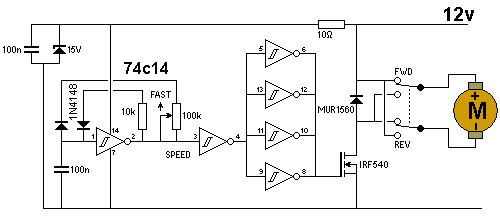
PWM 12v CORDLESS DRILL MOTOR
CONTROLLER
3-LED CHASER
This circuit let's you see how a FET turns on and how it works.
Remove the connections to the gate of the first FET and the LED will
start to illuminate.
The gate will start to get a charge on it and the FET will turn on.
Place a 1M between gate and 0v and the FET will turn off.
This shows the sensitivity of the gate. The charge on the gate must be
removed for the FET to turn OFF.
This circuit will show how the FET turns ON slowly as the voltage on the
gate increases and turns OFF slowly as the voltage drops:

WHY MOSFETs FAIL
There are quite a few possible causes for device
failures, here are a few of the most important reasons:
- Over-voltage:
MOSFETs have very little tolerance to over-voltage. Damage to devices may result even if the voltage rating is exceeded for as little as a few nanoseconds. MOSFET devices should be rated conservatively for the anticipated voltage levels and careful attention should be paid to suppressing any voltage spikes or ringing.
- Prolonged current overload:
High average current causes considerable thermal dissipation in MOSFET devices even though the on-resistance is relatively low. If the current is very high and heatsinking is poor, the device can be destroyed by excessive temperature rise. MOSFET devices can be paralleled directly to share high load currents.
- Transient current overload:
Massive current overload, even for short duration, can cause progressive damage to the device with little noticeable temperature rise prior to failure.
- Shoot-through - cross conduction:
If the control signals to two opposing MOSFETs overlap, a
situation can occur where both MOSFETs are switched on together.
This effectively short-circuits the supply and is known as a
shoot-through condition. If this occurs, the supply decoupling
capacitor is discharged rapidly through both devices every time a
switching transition occurs. This results in very short but
incredibly intense current pulses through both switching devices.
The chances of shoot-through occurring are minimised by allowing a
dead time between switching transitions, during which neither MOSFET
is turned on. This allows time for one device to turn off before the
opposite device is turned on.
- No free-wheel current path:
When switching current through any inductive load (such as a
Tesla Coil) a back EMF is produced when the current is turned off.
It is essential to provide a path for this current to free-wheel in
the time when the switching device is not conducting the load current.
This current is usually directed through a free-wheel diode connected anti-parallel with
the
switching device. When a MOSFET is employed as the switching
device, the designer gets the free-wheel diode "for free" in the
form of the MOSFETs intrinsic body diode. This solves one problem,
but creates a whole new one...
- Slow reverse recovery of MOSFET body diode:
A high Q resonant circuit such as a Tesla Coil is capable of storing considerable energy in its inductance and self capacitance. Under certain tuning conditions, this causes the current to "free-wheel" through the internal body diodes of the MOSFET device. This behaviour is not a problem in itself, but a problem arises due to the slow turn-off (or reverse recovery) of the internal body diode.
MOSFET body diodes generally have a long reverse recovery time
compared to the performance of the MOSFET itself.
This problem is usually eased by the addition of a high speed (fast recovery) diode. This ensures that the MOSFET body diode is never driven into
conduction. The free-wheel current is handled by the fast recovery
diode which presents less of a "shoot-through" problem.
- Excessive gate drive:
If the MOSFET gate is driven with too high a voltage, then the gate oxide insulation can be punctured rendering the device useless. Gate-source voltages in excess of +/- 15 volts are likely to cause damage to the gate insulation and lead to failure. Care should be taken to ensure that the gate drive signal is free from any narrow voltage spikes that could exceed the maximum allowable gate voltage.
- Insufficient gate drive - incomplete turn on:
MOSFET devices are only capable of switching large amounts of power because they are designed to dissipate minimal power when they are turned on. It is the responsibility of the designer to ensure that the MOSFET device is turned hard on to minimise dissipation during conduction. If the device is not fully turned on then the device will have a high resistance during conduction and will dissipate considerable power as heat. A gate voltage of between 10 and 15 volts ensures full turn-on with most MOSFET devices.
- Slow switching transitions:
Little energy is dissipated during the steady on and off states, but considerable energy is dissipated during the times of a transition. Therefore it is desirable to switch between states as quickly as possible to minimise power dissipation during switching. Since the MOSFET gate appears capacitive, it requires considerable current pulses in order to charge and discharge the gate in a few tens of nano-seconds. Peak gate currents can be as high as 1 amp.
- Spurious oscillation:
MOSFETs are capable of switching large amounts of current in
incredibly short times. Their inputs are also relatively high
impedance, which can lead to stability problems. Under certain
conditions high voltage MOSFET devices can oscillate at very high
frequencies due to stray inductance and capacitance in the
surrounding circuit. (Frequencies usually in the low MHz.) This
behaviour is highly undesirable since it occurs due to linear
operation, and represents a high dissipation condition.
Spurious oscillation can be prevented by minimising stray
inductance and capacitance around the MOSFETs. A low impedance
gate-drive circuit should also be used to prevent stray signals from
coupling to the gate of the device.
- The "Miller" effect:
MOSFET devices have considerable "Miller capacitance" between their gate and drain terminals. In low voltage or slow switching applications this gate-drain capacitance is rarely a concern, however it can cause problems when high voltages are switched quickly.
A potential problem occurs when the drain voltage of the bottom
device rises very quickly due to turn on of the top MOSFET. This
high rate of rise of voltage couples capacitively to the gate of the
MOSFET via the Miller capacitance. This can cause the gate voltage
of the MOSFET to rise resulting in turn on of this device as
well ! A shoot-through condition exists and MOSFET failure is
certain if not immediate.
The Miller effect can be minimised by using a low impedance gate
drive which clamps the gate voltage to 0 volts when in the off
state. This reduces the effect of any spikes coupled from the drain.
Further protection can be gained by applying a negative voltage to
the gate during the off state. eg. applying -10 volts to the gate
would require over 12 volts of noise in order to risk turning on a
MOSFET that is meant to be turned off !
- Conducted interference with controller:
Rapid switching of large currents can cause voltage dips and
transient spikes on the power supply rails. If one or more supply
rails are common to the power and control electronics, then
interference can be conducted to the control circuitry.
Good decoupling, and star-point earthing are techniques which
should be employed to reduce the effects of conducted interference.
The author has also found transformer coupling to drive the MOSFETs
very effective at preventing electrical noise from being conducted
back to the controller.
- Static electricity damage:
Antistatic handling precautions should be used to prevent gate oxide damage when installing MOSFET or IGBT devices. But are very reliable once they are soldered in place.
There are many more fact and circuits using MOSFETs on the web. This discussion is only a starting-point.
30/7/2010