|
Combination Lock MkII |
|
|
This project
puts a new emphasis on an electronic combination lock.
With just 3 buttons, we challenge you to crack the combination.

This project is built on the same board as LED FX and
uses the same components and the same circuit.
The main purpose of the project is to teach programming, however it also
offers a challenge to prove that a digital combination with just 3
buttons offers a very high level of security.
All sorts of tricks can be added to a design that uses a
microcontroller, including a time-delay if the wrong code is entered and
complete lock-out for 15 minutes if more than 10 different codes are
entered.
The project has 5 different combinations and each one is completely
different. It also has a feature where you can load your own sequence
and see if you can "find it again."
With our codes, you have absolutely no idea what we have have done with the
coding and it will be a challenge to try and crack it. It is doubtful if
you will succeed and it will be even more difficult to repeat the
sequence. The first two combinations are very easy, so don't think a
normal lock will be this easy.
The project is designed for all sorts of uses, including security for
your house, garage or back-shed. You can even include an alarm that
detects tampering and this will discourage anyone who thinks they can
work on the lock for hours.
The normal digital lock has up to 13 keys or buttons and 5,500
combinations and by progressively going through the combinations, you
will be able to open the door. The main reason why these locks are
difficult to "break" is the psychological aspect of letters instead of
numbers.
Simply replace the letters with numbers and the lock becomes much
easier to work with.
On top of this, they all have a "C" cancel button at the lower corner so
don't touch this when trying a code.
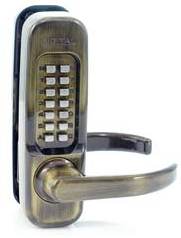
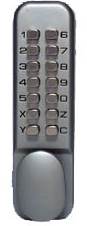
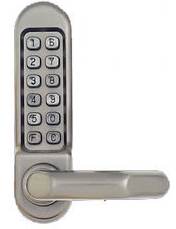
A digital lock has an unknown number of sequences and and
the final code in our series consists of two parts. When you crack the
fist section, the 3 LEDs flash and then you need to enter the next code
for the lock to open. The chances of getting two sequences in a row is
minuscule. That's the same as the web introducing a password as well as
a username.
models such as
train layouts, alarms and similar effects.
It can also be expanded to accept more LEDs and these can be placed
on a separate display board.
But the real thing we want to get across, is programming.
This is another example of using a simple 8 pin chip to provide a number
of features that would take many logic chips (such as counters and gates) and lots of components to
duplicate.
It also highlights our method of hand-coding as an effective way to
produce a program.
It is doubtful if the same effects could be produced on any of the
pre-packaged microcontroller modules, using a tiny 8 pin chip.
This project uses about 400 instructions to produce the effects and it uses the EEPROM to store the sequence
produced by the user (sequence 1) - and show it at turn-on.
In this respect, some of the sub-routines in the program are quite complex and suitable
for the advanced programmer. However, if you are a beginner, you can
read through the program and most of the sub-routines will be easy to
follow as each line of code is explained. You have to start somewhere
and this project offers a challenge.
Most projects with a program of this complexity are only available as a
pre-programmed chip or only the hex code is available. There is usually no
attempt at educating the reader in programming.
That's the difference between our projects and all others.
We offer a learning curve.
For every hour of effort you put into reading, building and using one of
our microcontroller projects, you get the experience of 100 hours of
effort that has been put into the design to make it appear simple.
All you have to do is start . . .
|
INSTRUCTIONS FOR USE There are 6 codes. The first code can be created by the user. It is currently not programmed. The other 5 sequences are pre-programmed. Turn project ON. Push the first button (called SwA) and hold it down and the program will change to the next code. Release the button and solve the code. The three LEDs will flash when the code is broken. Turn the project off and push SwA two times quickly for the second code. The program waits for 500mS between pushes to index the codes. If SwA is not pressed for 500mS, the program goes to the appropriate sequence and waits for the correct sequence of button-presses. The fisr LED will flash the appropriate number of times to indicate the code number you are trying to "break." TO CREATE YOU OWN SEQUENCE. 1. Press SwA and at the same time, turn project ON. 2. Release SwA and press the switches in any order (up to 15 steps). A step or delay cannot be longer than 2 seconds as the program will "time out." When finished, wait 3 seconds and the sequence will show on the LEDs. 3. Turn project off and on. The new sequence will appear as the first sequence. TO MAKE ANY SEQUENCE THE FIRST SEQUENCE Any of the sequences can be saved as the first sequence, as follows: 1. Turn the project ON and increment the sequences. 2. To save the desired sequence, press SwB. The display will die. 3. Turn project OFF then ON. The desired sequence will show at start-up. 4. To delete this feature, push SwC and at the same time, turn project ON. |
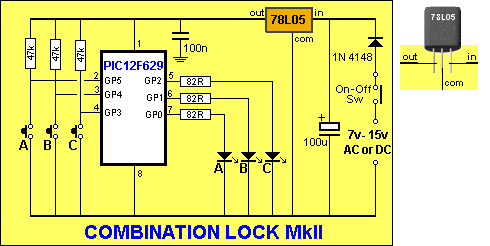
Combination Lock Circuit
The CIRCUIT
The circuit is very simple. It is
just 3 LEDs and 3 switches. All the work is done by the micro.
We have added a 5v regulator and diode so the project can be connected
to all sorts of voltages.
It will work on 6v if the regulator is removed or on 7v to 15v (AC or
DC) with the regulator fitted to the board.
This makes it suitable for a 9v battery or the AC supply from a model
railroad. I know you are going to say "it is inefficient using a 9v
battery" but it is convenient.
THE LEDs
The LEDs supplied in the kit are ultra high-bright white LEDs. They are
too bright to look at directly but can be used for all sorts of
applications and effects. You can change them to suit your own
application.
CONSTRUCTION
You can build the circuit on any
type of PC board and we have used a small piece of matrix board.
The kit of components comes with all the parts you need to get the
project working, including a pre-programmed chip and the matrix
board.
To modify the program you will need a PICkit-2 programmer and this comes
with 2 CD's containing all the software needed for In-Circuit
Programming.
You will also need a lead (comes with PICkit-2) to connect the programmer to your lap top via
the USB port and an adapter we call 6pin to 5 pin
Adapter to connect
the PICkit-2 to your project.
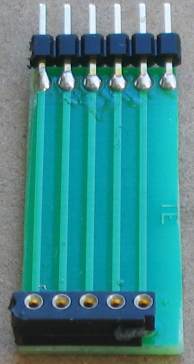
6pin to 5pin
Adapter
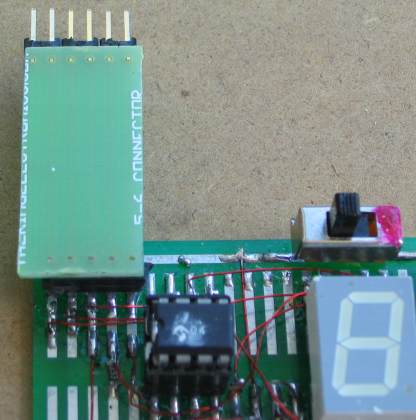
Adapter connected for In-Circuit Programming
(the chip is placed in another project for in-circuit
programming)
Combination Lock MkII
Underside of board
PROGRAMMING THE
CHIP
The kit comes with a pre-programmed PIC chip but if you want to program
your own chip or modify the program, the .hex file is available as well
as the assembly file, so you can see how the program has been written
and view the comments for each line of code.
The PIC12F629 is one of the smallest micros in the range but you will be
surprised how much can be achieved with such a tiny micro.
The program contains sub-routines to produce delays, sequences on the
display and both read and write EEPROM; jobs that require accurate code
- including a special sequence - called a handshaking sequence that
prevents the EEPROM being written due to glitches.
Even a program as simple as this is not easy to put together and to
assist in this area, we have provided a whole raft of support material.
Not only do we provide a number of programs with full documentation but
our approach to programming is simple.
It involves a method of "copy and paste" whereby sub-routines
are taken from previously written code and copied into your program. Any modifications are
made in very small steps so that each can be tested before adding more
code.
This is exactly how we produce a complex project. Each step is written
and tested before adding the next step.
This saves a lot of frustration as it is very easy to add a line
of code that is incorrect and get an unsuspected result.
If you follow our suggestions you will buy a programmer ("burner")
called a PICkit-2 if you are using a laptop. It is the cheapest and best on the market
and comes with
a USB
cable and 2 CD's containing the programs needed to "burn" the chip.
If you are using a desk-top and/or tower with a serial port, you can use
a cheaper programmer called MultiChip Programmer from Talking
Electronics. You
will also need NotePad2 to write your .asm program. This can be
downloaded from Talking Electronics website. You will use
LED_FX.asm or
LED_FX-asm.txt as a template for your
program, plus a 6 pin to 5 pin connector that fits between the burner
and the project. This is also available on Talking Electronics website.
As we said before, this project is for medium-to-advanced programmers as
it is very compact and does not have in-circuit programming pins.
To be able to modify the chip you will need a programming socket and
this can be obtained from one of our other projects that contains the 5
pins for in-circuit programming.
You can then put the chip into the other project to be programmed and
modified and re-fit it into this project for execution.
PROGRAMMING LANGUAGE
There are a number of kits, programs and
courses on the market that claim and suggest they teach PIC Programming.
Most of these modules and courses use a PIC microcontroller as the chip carrying out
the processes, but the actual programming is done by a proprietary
language invented by the designer of the course.
Although these courses are wonderful to get you into "Programming
Microcontrollers" they do not use any of the terms or codes that apply
to the PIC microcontroller family.
All our projects use the 33 instructions that come with the PIC
Microcontroller and these are very easy to learn.
We use the full capability of the micro and our pre-programmed chip is
less than the cost of doing it any other way.
In addition, anything designed via our method can be instantly
transferred to a PIC die and mass produced. And we use all the input
pins and all the memory of the chip. The other approaches
use less than 25% of the capability of the memory and one of the pins is not available.
In fact it would be difficult to reproduce this project via any of the opposition
methods. It would require a larger chip and more expense.
You can use our method or the opposition. Just be aware that the two are
not interchangeable.
Ours is classified as the lowest "form" (level) of programming - commonly called
machine code - invented in the early days of microprocessors - and now
called mnemonic programming as each line of code is made up of
letters of a set of words. The opposition uses a higher level language
where one instruction can carry out an operation similar to a
sub-routine.
But you have to learn the "higher level language" in order to create a
program. And this requires a fair amount of skill and capability.
It sounds great and it is a good idea. But if you want to learn PIC
programming, it does not assist you. It is "a step removed" from
learning PIC language. The other disadvantage of the opposition is the
"overhead." The 1,000 spaces allocated for your program is filled with
pre-written sub-routines. You may require only 10 of these sub-routines but ALL
of them are loaded in the memory space. And they take up all the memory.
You have no room for your own program.
To get around this the opposition uses the 128 bytes in EEPROM to deliver
instructions on how to apply the sub-routines. This provides about 30 powerful instructions using their
language called BASIC (or a similar language).
It's a bit like selling a diary filled with all the paragraphs you need
to express yourself, and leaving a few blank pages at the back for you
to write single lines such as: see page 24, paragraph 7, see page 63
paragraph 4, to create your diary entries.
It depends on how much you want to be in charge of writing a program. Using
our method is like writing your own auto-biography. Using the opposition
is like getting a "ghost writer."
When using a higher level language to create a program, you have absolutely no
idea how the code is generated for the micro.
In some of the developmental kits, the code is "locked away" and you are
NEVER able to access it.
Everything runs smoothly until a fault appears. With our method you can
see the code. With the other methods, you cannot see the code - it's
like doing key-hole surgery without the advantage of an
illuminated endoscope to see what you are doing.
Everything has its place and our method of hand-assembly is only
suitable for very small micros and you will eventually need to "learn a
high level language." The PIC12F629 has over 1,000 locations for code
and this equates to more than 20 pages when printed, so this is about
the limit to doing things by hand.
But our drive is to show how much can be done with the simplest devices
on the market, at the lowest cost.
Anyone can show you high-technology at a high price but this is not
where you start and this is not where you get enthusiasm.
We provide the things to get you started. That's the difference.
The
PROGRAM
The program does a bit of
detecting when turned on. It detects to see if a bit has been set in
EEPROM to tell the micro to go to a required sequence or start with
code 1.
It also detects if switch A or C has been pressed at the instant the
project is turned on so that the micro is directed to the sub-routine
where the user-sequence can be entered or if the EEPROM bit is to be
cancelled.
All this gets done in the SetUp routine and then the micro goes to Main.
In Main, the program increments a "jump" file and calls a table where it
finds a directive to go to a particular sub-routine.
The sub-routine is executed and the micro goes back to Main where it
looks for a release of SwA. This forms part of a key debounce as the key
must be fully debounced as it is advancing the micro through the
sequences.
To provide a totally reliable debounce, the key is detected as not being
pushed for the duration of a whole cycle of a sequence and a separate loop is then executed where the key can be
detected as being pushed, to advance the program to the next sequence.
To create your own sequence as sequence1, the project is turned off and
SwA pressed while turning the project ON.
This sends the micro to a sub-routine called Attract.
As soon as SwA is released, the program starts to time the duration when
a switch is not pressed and it "times-out" after 2.5 seconds.
The program also times the duration when a LED is illuminated. It also
accepts 2 or 3 LEDs illuminated at the same time. These are all clever
instructions that need to be looked at to see how they operate.
Up to 15 steps can be entered and each step occupies three bytes. The
first value identifies the illuminated LEDs, the second byte identifies
the ON duration (in increments of 5mS) and the third byte identifies the
OFF time.
These 45 bytes are contained in files 30h to 5Fh.
When a switch is not pressed for 2.5 seconds, the program "times out"
and sends the values to the EEPROM. It then shows the sequence on the
LEDs.
If the project is turned off and on again, this sequence will be
displayed as sequence1.
To replace the sequence with something else, simply repeat the steps above.
If you want one of the pre-programmed sequences to appear each time the
project is turned on, simply advance through the sequences by
pressing SwA and when the desired sequence is playing, push SwB.
This will record your choice. Turn the project OFF then ON again and the
chosen sequence will be displayed.
To remove this feature, press SwC when the project is off and at the
same time, turn the
project ON.
All these feature have been added to the program, one at a time, and it
is important to add them in the correct order. For instance, you can only add a removal feature after the
initial feature has been produced. Reading and writing to the EEPROM is
a most complex operation and the instructions must be laid out as shown
in the program, as they include a hand-shaking sequence. When you need this
code it is copied and
pasted in its entirety, to prevent a mistake.
Nearly every instruction has a comment to explain not only what it does, but why it was chosen.
If you think you can start programming without reading programs from
other developers, you are wasting your time.
No individual can work how to do many of the tasks via the simplest set
of instructions and you will find some programmers have used complex
code to do the simplest task.
That's why you have to pick out the "wheat from the chaff" and
remember a good routine, while discarding the over-complex sets of code.
This brings up an important point.
Don't expect to be an A1 programmer in a week. It takes time to absorb
the skills of programming and it is really only understood by a
microscopic percentage of electronics enthusiasts. If you take it up and
understand it, you are one of the microscopic few.
It is a world that, once you are in, will open up a whole new field of
ideas and development.
It's like taking up a new spoken language and, in fact, a program reads
like a book, so the analogy is very close.
There are some very "clever" instructions such as XOR where you can
compare two files by using the XOR function and determine if they are
the same. And very powerful instructions such as djnz that decrements a
file and if it is zero, the micro jumps over the next instruction.
Other clever instructions transfer the contents of a file to another via
the "carry."
You cannot be expected to know these "tricks" unless you
study programming. That's why we are here.
Here are the files you will need:
LED_FX.asm
LED_FX-asm.txt
LED_FX.hex
;******************************* ;;LED FX.asm ; 11-3-2010 ;******************************* list p=12F629 radix dec include "p12f629.inc" errorlevel -302 ; Don't complain about BANK 1 Registers during assembly ;**************************************************************** ;*EEPROM * ;**************************************************************** org 2100h END |
GOING
FURTHER
We have not produced all the
possible codes and you can add more by simply creating
a new sub-routine. This can be stored as code 1 and can be used as soon
as the chip is turned on.
Or you can add it to the table and make sure you end with retlw 00
to send the micro back to Main. You will understand what we mean when
you start programming.
We have provided all the hardware and software for you to do this.
Now
it's now up to you.
|
|
|
12/7/10